Before I get into this, I want to make one thing clear: this isn’t about moral judgement or assigning blame. It’s about being honest when we define the problem. It’s really hard to solve a problem when you define it poorly, and we’re bad at this one as a society. We preach stupid diets, market miracle exercise machines, and blame the people who fail when these things don’t work for very obvious reasons.
So let’s define it honestly.
We all accept that gaining weight is easy. Nobody argues about that. If you run a caloric surplus, even a small one, regularly, you gain weight. The equation is very simple:
Calories in − calories out = weight delta.
Two levers. Diet on one side (calories in), activity on the other (calories out). I’m going to mostly ignore BMR, the calories you need just to stay alive, because it’s mostly outside our control. Some behaviors change it, e.g. your metabolism can slow if you restrict calories hard, but that’s a downstream effect of how we pull the other levers, not a lever itself. I’m also going to ignore that different macros have different impacts, absorption pathways, and bioavailability because it doesn’t matter when thinking about weight as a framework. Don’t get all your calories from any single macro, and don’t get the majority of your calories from saturated fat. Both of those things have long-term health consequences that are worse than carrying a little extra weight on your body. Beyond that, keep the model simple. Complexity here just creates noise.
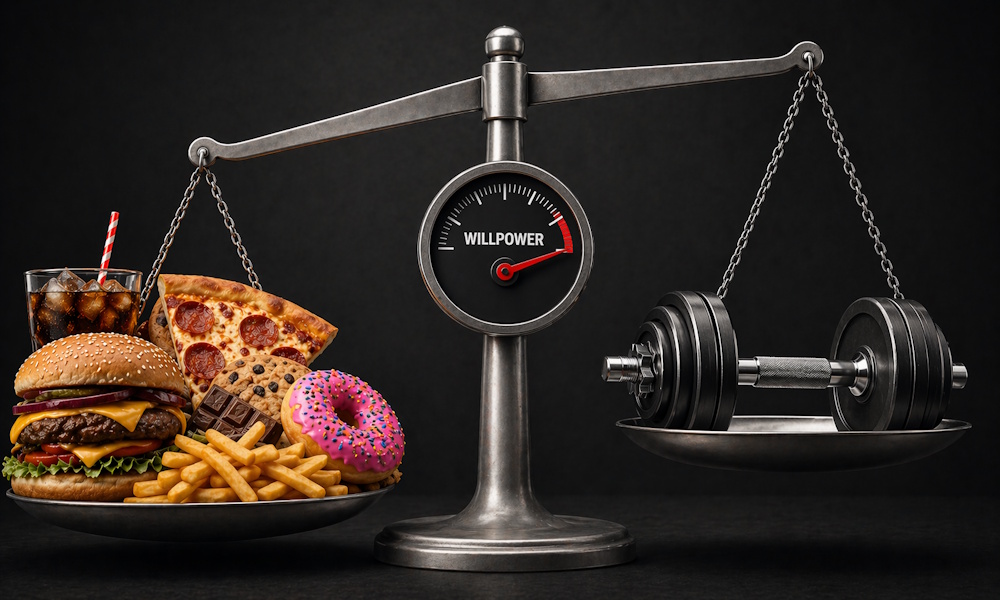
The point I want to make, the one I get pushback on, is this: weight is a math problem, but we have to solve it as a willpower problem, because that’s where the levers are. The math describes the outcome. The math is honest, but the math isn’t actionable. You can’t grab the calories-in-calories-out equation and wrestle it into submission. What you can grab is your own behavior. So while the problem is math, the solution is willpower applied to behavior, and that’s the part we need to be honest about.
Let’s do some quick math to demonstrate. A couple cans of Coke is 280 calories. Do that every day for a year and you’re adding 102,200 calories to the system. At the rough 3,500-cal-per-pound approximation (which is a simplification, but close enough to make the point), that’s about 29 pounds a year. Adding those two Cokes was effortless, you just drank them. Taking them away is also effortless, you just don’t drink them. Where we struggle is making that choice, because not drinking them feels like suffering, even though the physical act of skipping a Coke doesn’t harm you. The suffering is in your head.
That’s the willpower part. Easy concept, more difficult in application.
Exercise
Most of the non-highly-active people I talk to about this primarily think about the exercise lever. They’ll add a 15-30 minute walk and wonder why the pounds don’t melt off. I understand the frustration, but the data here is pretty clear: exercise alone is a weak tool for weight loss unless you do significant volume.
A 2024 meta-analysis in JAMA Network Open (116 randomized trials, 6,880 adults with overweight or obesity) found that aerobic exercise under 150 minutes per week produced minimal weight loss. To get clinically meaningful loss, 5 to 7.5 kg, required 225 to 420 minutes per week. An older, similar meta-analysis (Franz 2007) was blunter: exercise-alone groups showed “minimal weight loss at any time point”.
Significant volume is something like 10+ hours a week. That’s what it takes to really move the needle on weight through exercise alone, and almost nobody can carve out 10 hours a week. I ride a lot more than that, but I’m not normal, and neither are you if you’re doing 15+ hours.
Here’s the thing that gets lost in the “just exercise more” advice: three hours a week gets you the majority of the health benefit. Cardiovascular fitness, bone density, mental health, insulin sensitivity, reduced all-cause mortality, most of that curve is front-loaded in the first few hours. Pretty much anyone can find three hours a week, and they should. We need to be honest that weight loss is probably not going to be one of those benefits at three hours a week. I have a couple posts (one, two) with various time budgets. TL;DR – if you only have three hours, 3x a week lift 15-20m, cardio 15-20m (make it hurt), don’t ignore your core 15-20m.
So for most people, the lever that’s actually available is calories-in.
Which, circling back to the Cokes, is a willpower problem.
Willpower
I used to believe that willpower is mostly nurture. That if you were raised in a household where food was plentiful and casual, or where food was scarce and charged, you’d have a harder time with it as an adult, that it was fundamentally a learned thing. The data doesn’t support that. We need to follow the data. That’s how we get real solutions.
The Willems et al. 2019 meta-analysis in Neuroscience and Biobehavioral Reviews, pooling 31 twin studies and more than 30,000 twins demonstrates this. It puts self-control heritability at about 60%. That’s a big number, meaning roughly 60% of the difference between people in their ability to regulate impulses is genetic. Much bigger than I would have guessed, and bigger than I would have believed if someone told me before I looked into it.
The environmental piece really surprised me. Shared family environment contributed essentially nothing. Twins raised in the same house were not any more similar in self-control than you’d predict from their genes alone. The environmental variance that does exist is non-shared, i.e. individual experiences, things you went through that your sibling didn’t, skills you specifically learned. Your genes hand you a starting point for self-control, and that starting point is substantial. Your shared family environment probably had less to do with your adult self-control than you’d think. The 40% that isn’t genetic is shaped by your individual experiences and choices, including what you deliberately practice.
Same story on the weight side. BMI heritability runs 40-70% in twin studies, this is one of the more robust findings in the field. Some people’s bodies defend a higher set point, and they’re not making it up. If you’ve ever lost significant weight you know the body fights you on it. Hunger hormones shift against you and stay shifted for years after the weight comes off (Sumithran et al. 2011 in NEJM). The body is not neutral about weight loss. It is actively resisting.
This is why the math-is-symmetric point is true at the equation level and misleading at the behavioral level. The calories are symmetric. The body is not. Adding 280 calories doesn’t trigger a hormonal counter-attack. Subtracting them does. That’s another reason we have to solve this with willpower: the math doesn’t fight back, but the body does, and willpower is the tool you have to override the body’s resistance. The difficulty isn’t knowing what to do. The difficulty is overriding a physiological system that’s actively working against the thing you’re trying to do.
So when I say losing weight is easy, I mean the action is easy. Skip the Cokes. Don’t eat the second helping. The math is easy and the action is easy. The behavior that executes on the math is hard, and it’s hard partly because you’re fighting your own biology, and partly because you’re fighting a starting hand you didn’t choose. None of this is an excuse. It’s a more accurate definition of the problem.
What you can do about it
The good news in that 40% non-genetic slice is that willpower responds to the same things every other skill responds to: deliberate practice, structured environments, and not trying to white-knuckle everything at once.
The oldtimey version of willpower, gritting your teeth and refusing temptation by force, is mostly a losing strategy. The “willpower as a finite muscle that depletes” model (ego depletion) has largely failed to replicate in recent meta-analyses. What actually works is using willpower once, at the right moment, to reduce how often you need it later. Don’t buy the Coke at the grocery store. Then you don’t have to resist it at 4pm. That’s not a character trait, that’s environmental design, and it’s learnable.
Cognitive behavioral therapy (CBT) works on the same principle, more formally. You identify the thought patterns that connect your goals to your behaviors (or fail to), and you rebuild them through repetition. It’s not magic, it’s practice. Most people won’t need formal CBT, reading about habit formation and applying it with some discipline will get you most of the way, but if you’ve genuinely tried and can’t get traction, it’s a real tool and it works.
Start small. Small problems are easier to fix than big problems, and most big problems are just a series of small ones. Pull out one or two, fix them, pull out a couple more. Productive mental frameworks don’t happen overnight. They take practice, and failure, and honestly acknowledging when something isn’t working. If you want some specific tactics, I wrote a post a couple years ago which speaks to managing the calories-in side of all of this, there are several practical tips.
GLP-1 agonists are a valid tool, no judgement
GLP-1 agonists (Ozempic, Wegovy, Mounjaro, Zepbound) are, functionally, a pharmaceutical method to manufacture willpower. They do a few things in the body, but the main effect people care about is that they reduce food noise and increase satiety. You just think about food less, and when you do eat, you’re full faster. The calories-in lever becomes dramatically easier to pull.
The data on their effectiveness for weight loss is not controversial. The STEP and SURMOUNT trials showed 15-20% body weight loss on semaglutide and tirzepatide respectively. That’s more than any non-surgical intervention has ever produced at scale. For a lot of people these drugs are legitimately life changing, especially people with metabolic disease where the weight itself is actively killing them.
The problem is what happens when you stop.
STEP 1 extension followed patients after they stopped semaglutide. Within a year of discontinuation they had regained about two-thirds of the weight they’d lost. SURMOUNT-4 did the same thing with tirzepatide and found patients who switched to placebo regained around 14% of body weight over 52 weeks while the group that stayed on the drug kept losing. A 2026 meta-regression in Lancet eClinicalMedicine estimated long-term weight regain at about 75% of the weight lost at steady state, with a half-life of about 23 weeks. A 2026 BMJ meta-analysis of 37 studies found that people who stopped semaglutide or tirzepatide regained an average of 9.9 kg in the first year and were projected to return to their baseline at about 18 months.
The evidence is unambiguous here. Most people who stop gain it back.
That’s not a drug failure, that’s what the biology predicts. The drug was holding down the set point. Stop the drug, the set point reasserts itself, the body does what it always wanted to do.
The implication isn’t that GLP-1s are bad. The implication is that, for most people, they’re a chronic medication, not a detox. You take them the way someone takes a statin for cholesterol, or a beta blocker for blood pressure. This is how they are being positioned by some manufacturers, and it’s consistent with how the American Association of Clinical Endocrinology now talks about obesity (as a chronic relapsing disease). There is some developing data suggesting that dose tapering paired with structured exercise and behavioral work (i.e. the CBT stuff) reduces regain versus abrupt discontinuation. That’s small-sample and “conference-abstract level” at this point, so let’s call it “developing”, but it’s directionally consistent with what I believe, which is that the drug works best paired with the behavioral work, not as a substitute for it.
Which brings me to gatekeeping.
There is a loud subset of the “you need to work on your willpower” club that treats GLP-1 users as cheaters, or as morally weak. This is stupid, and I say that as someone who clearly thinks willpower is important and worth working on.
If we had infinite time and there weren’t serious health consequences associated with carrying too much body fat, maybe there would be a morality play here. There isn’t. Being overweight has real cardiovascular, metabolic, and longevity consequences. If a drug reduces those consequences in a way that lifestyle alone could not for this person, using it is the correct choice.
I also think it’s worth pointing out that the same people who sneer at GLP-1 users are often totally fine with statins, SSRIs, blood pressure meds, and asthma inhalers. If you have myopia, we give you glasses, we don’t tell you that you suck because you can’t see things that are far away and should just move closer. If the argument is that you shouldn’t use a drug to manage a chronic condition that has a behavioral component, that argument has implications.
In the same way we need to be honest about how we define the problem, we need to be honest about realistic ways to solve it. For some people that’s diet and exercise. For some people that’s diet and exercise plus CBT. For some people that’s diet and exercise plus a GLP-1. For some people that’s bariatric surgery. Which of those works for which person depends on the person, and it’s not a moral ranking.
It’s easy for me to say all of this
One of the things I get pushed on is that it’s easy for me to say all of this being who I am. There is some truth there, and I want to be honest about it.
My genetics make me slim and I was raised in a Calvinist household, where suffering now for a poorly defined future reward is a fundamental tenet. Both of those things help. I also have enough mental trauma that endurance sports appeal to me. I like data. I lean into the data when I find a problem with something I’m doing, or not doing. That isn’t strictly willpower. That’s my starting hand.
That said, I mostly am the way I am because I apply this framework to myself, poorly and often. I’ve gone through periods where I didn’t control my diet and had to buy new pants because I stopped fitting into the old ones. My cholesterol and blood pressure got to a place that concerned me. So I applied willpower to change my behavior to fix those problems, and they got fixed. Which has allowed me to relax some of the changes I made. I still monitor these things because I don’t want them to get back to a place where I need to aggressively alter behavior again. The framework works when I actually apply it.
I also fail at this framework regularly. One of the hardest parts is remembering that it’s OK to fail, and that’s an area where I had to get help. I have GAD and OCD, which means my brain is very good at turning small failures into personal failings. That’s not a willpower problem, that’s a clinical thing, and trying to brute force it just made it worse for years. Asking for help, learning how to use CBT to generate behavioral change was one of the most important things I’ve done, and I wish I had done it sooner. My health and relationships suffered because I refused to address it in a timely way. It is OK to admit you need help, and to get it. For the mental health stuff, staying inside the traditional medical system worked for me.
The physical side was harder. I talked about it a little last year. My GP was not helpful with any of the concerns that I brought in. I had to do the bloodwork myself, pay for it out of pocket, do a massive amount of research and find providers that would help me figure it out. I’ve had to apply the same willpower framework to force that process forward, and it’s working (I think). I can now address the things that are probably driven by genetics by defining the problem honestly and using data to weigh risk, benefit, and outcome. Same framework, different domain.
The point isn’t that I’m some special case. The point is that none of this is free for me either, it may look that way from the outside because no one can see the hours and effort I put in to manage my weight and physical/mental health. Everyone who looks like they have this figured out is running the same loop that we are. Maybe they’ve been running it for longer and have fewer visible problems. That’s all it is.
Start small, be honest about where you are, get help when you need it, and keep going.